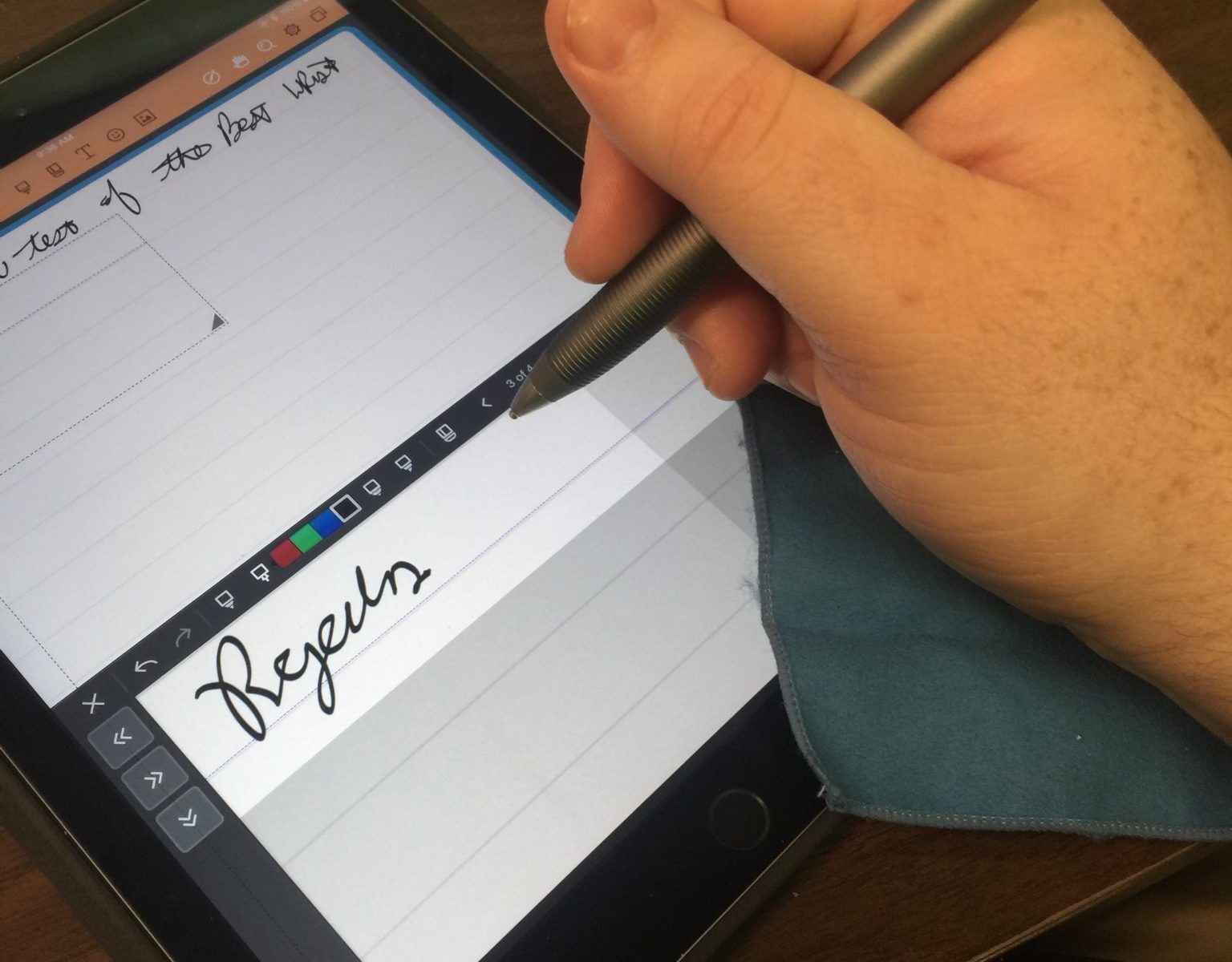
One of the biggest challenges I’ve had when using a stylus on my iPad is the problem of palm rejection. It seems that no software tweak known can keep my palm from screwing up what I’m writing on the iPad. But today I had a revelation – a microfiber cloth (that I carry with me anyway) make the best “wrist rest”. My writing speed immediately amped up, and I’m much happier with the results as well. Give it a try next time you’re writing on a screen – the added bonus is it also cleans the screen rather than smudges it while you move your wrist around!
Today, many professors share the same responsibilities as our counterparts in other industries. We need to answer emails, attend mandatory HR trainings, and have conversations about recruitment, retention, and image. But one thing we don’t usually have is the staple of many in the working world: An ID badge to be worn while at work. At the most, we have something like this, a name badge used during “open-house” events where members of the public, or new students, may be in attendance.
My Delta State name badge
When asked* to wear our badges, we generally grumble and dig them out of our bags or desk drawers, reluctantly put them on, and wander out to the event. Most professors consider them a nuisance, however I’d argue that, when used effectively, they are far more important than we think. They are a visible way we show our affiliation, at a time when higher education (whether it wants to or not) needs not only affiliation, but brand presence.
How does a name badge advance a brand? Well if executed poorly, it doesn’t. I’ll give you an example of good execution (in my opinion) first. At Delta State, all of our name badges have the same size, shape, and style: Black lettering on a gold background. Each year there are very subtle differences depending on the shop that we order from, but unless you hold badges side-by-side you won’t really notice the font shift, bolder letters, or 1-2 point size differences in text. When ‘outsiders’ come to an event, all Delta State faculty and staff are immediately recognizable about a mile away, which means that people have no trouble asking us questions ranging from “Where are the bathrooms” to “Do you teach here?” to “Can you tell me about the XYZ program?”. We appear organized because our badges match, even if sometimes we might not have all the answers. Last week, for example, a new orientation student who was visibly confused flagged me down asking for help understanding her schedule. 2 minutes later and a quick look at her schedule and she was off happily, profusely thanking me.
Contrast that to a previous institution I was at where name badges were a very informal thing. Each year the design changed rather markedly – the background was white one year, red another, white again the next. Sometimes the logo of the school was on the badge, sometimes it wasn’t. Folks who had been around 10+ years had a much older design with just a single bar and their name, while newer badges had the same information mine does above. And unless you mentioned it a few times, you might not even get a badge (I never did), even as a full time faculty or staff member. While I’m sure the administration cared about them in theory, in practice it was a free-for-all. To the public, this sends a message of disorganization (Which at that school was more accurate than desired), and while we had a quality product to offer, we didn’t appreciate how the little details mattered.
The DSU Division of Counselor Education & Psychology at the Greater Memphis National College Fair, September 2014.
At DSU, branding seems to be doing it’s job in terms of recruiting students in tough times. Last year we had our first year with increasing enrollment in over a half-decade, and we’re hopeful for another increase this year. When we go to academic / college fairs, our tables look uniform, our faculty and staff are easy to spot, and we project an image of professionalism that many other institutions lack. As academics, our number 1 priority is, and always will be, providing a quality education to our students. But we cannot become so jaded as to believe that appearance, marketing, and branding have no impact on our abilities to do our jobs. People notice if your logos are different, business cards vary greatly, and name badges don’t match. And what can admissions folks tell to those people when they ask “Will my son be able to graduate in four years or will an advising error happen like it did to my daughter at ?”. They can assure them that we take advising seriously (and at DSU we definitely do), but if it looks like they can’t even coordinate their own letterhead, will they be believed?
** I originally wrote “required”, however if you’ve spent time in academia, you know that there are always a handful of professors that will laugh in the face of such ‘requirements’.
Gather round for this history lesson, youngsters, as I tell you about this bad boy – the Royal DM2070 Organizer
(That’s right, it had a flip cover)
As best as I can remember, I bought this thing sometime in 1999 for around $30. This was a time long before smartphones, when the best PDAs around were still quite expensive. I was a broke high school kid who had data to store, and this bad boy fit the bill.
What did I have to store? Funny you should ask. In 1999 Karey & I started dating, and we ran into a weird problem that also seems prehistoric today: the prohibitivly high cost of voice contact. While we could chat through our dialup internet connections, no good voice solution existed – especially at the speeds we both had. So I spent a lot of money on pre-paid phone cards to avoid the anger of my dad (upon reviewing the phone bill). I also found places online to get pre-paid cards via email, and at the end of the day had a list of PIN codes that would give me 10-30 minutes of talk time.
As you can probably guess, teenagers talk a lot more than 30 minutes at a time, so I had a lot of codes to keep track of – which ones I’d used, which ones I hadn’t. I printed them out briefly, but began to weary of all the paper I had lying around. So I bought this thing and used it’s “memo” feature to put in the lists of codes (which was easy given the numeric keypad). I did this for a few months until I found a flat-rate long distance service in 2000 that let me pay only $80 a month for unlimited long distance. Ah the expense of romance before Skype and Broadband!
I found the Royal organizer yesterday while cleaning, and decided to see if it still powered on. And yes, after 16 years, it not only powered on, but it had the correct date! Time was off a bit, but the date was spot on. Goes to show – just because you’re old, doesn’t mean you’re out of the game!
… Remembering to update the page. Was asked today to take on additional web management duties at DSU (We’re making a push to have up-to-date contact information for everyone). Not a big deal – the contact system is very functional and takes very little time to update. It’s a push to de-centralize updating it, which makes a lot of sense, as long as people are on board. It is hard to find an organization with a “vibrant” web page that has decentralized administration of that page. Yet it’s even harder to find a large organization that can devote people solely to web updating. The classic conundrum: updating web pages tends to be a NIMBY issue (not in my back yard!) Everyone agrees it needs to be done, no one likes to do it. Hopefully as the bar gets lower and lower in terms of ‘hassle’ (i.e. modern CMS’s do a great job of making it easy to publish / update things), we’ll get rid of the 3 year old webpages that should have been updated last month.
Karey & I are watching Star Trek Deep Space Nine, and we just finished the three episode arc that starts the second season (The Homecoming, The Circle, & The Siege). I haven’t watched those episodes in about 15 years, and you know what impressed me? The extreme lack of something: Explosions.
You see, back when I was growing up, you could have a story unfold over 135 hours with just a couple of small firefights (4 that I can think of) and some limited effects. The story was the point, it’s what people tuned in for. The eye candy was… well, just eye candy. Today I don’t think any network or producer would let that slide (One could argue this was exactly what made TNG & DS9 special: Lack of a network overseer). Today you’re much more likely to find directors like Peter DeLuise who scream “B-I-G-G-E-R” – if we don’t see things blowing up and people shooting for at least five minutes at a time, it’s not worth it.
Which is a shame. When I think about the influence Star Trek had on my early life, I realize that I found it far more interesting to take the non-force option into account to get where I wanted. Sure, I was big enough that I could use force – be physically intimidating – but that just led to consequences. Usually short-term gain and long-term pain. Pull a page from the Picard playbook and you get where you want to be with little collateral damage (usually). I think we’ve lost some of that in recent years – we’ve forgotten that we can use diplomacy, cunning, words and subtle actions. When I think of my leisure activities now – which are principally centered around spending time with others and learning about them, I see the influence of Trek. Thank you Star Trek, for teaching me as a young adult to not only enjoy story-based Sci Fi, but also story-driven life.
As someone who knew nothing about college before stepping on a college campus, day 1, I sometimes find that things I take for granted now were completely unknown way back then. This mostly occurs when I see people on social media make comments that I shake my head at and say “Uh, that’s not how it works”. So I’ve decided to write up a few of these “Academia Public Service Announcements”.
The first one, below, talks about how one gets into graduate school. I see a lot of comments to my seniors that go something like this:
“Oh, you met the requirements – you’ll be able to get into any program you want!”
or
“I’m glad you chose where you want to go, they’ll take you for sure”
Both of these statements slyly imply something that isn’t true: Graduate admission is NOT like applying to college. It’s way more traumatic 😉
Here’s what I mean: The typical undergraduate admission process goes like this:
Student finds college he or she is interested in, and checks admission requirements.
If student meets requirements, and school is not ultra-selective (and unless you’re in the Ivys, not many are), student applies. If school is ultra selective, student must decide if the admission liklihood is worth the application hassle!
Student may have a few hoops to jump through, but in the end they are offered admission.
In this scenario, the school is admitting hundreds (or thousands) of students, and unless they’re very selective, they will take anyone who meets their requirements. Schools want to take as many as possible, that’s how they get tuition dollars!
Graduate admissions tends to run like this:
Student finds program he or she is interested in. Programs exist within departments – the goal here is not to find a school you want, as much as the program you need to go into a career you want to enter. So don’t tell your friend or child “Why would you want to go THERE?!?” – they didn’t pick the school, they picked the program!
Student does a lot of research on that program, reading all those web pages that most glance by (i.e. faculty profiles, degree requirements, etc…). Student hopefully identifies 1-2 faculty members in that program they would want to work with.
Student applies and must meet minimum qualifications for that college or university’s graduate admissions. Assuming that they meet those, the graduate admissions group forwards their application on to the program.
This is where people often get confused: They hear that their’s (or someone they know, a son’s, daughter’s, friend’s) application has been forwarded on and assume they have some small level of acceptance – but in graduate admissions, the graduate admission group has very little power over who gets in! They simply check qualifications, gather the paperwork together, and forward it on.
It’s all about the actual program’s graduate committee and faculty – if they think the student would be a good fit (Most important), and they’re taking graduate students (Some professors skip years taking new students), then they may offer an interview to the prospective student. Remember, each program is only going to take 5-10 students a year across all faculty members in it. Their goal is NOT to take as many students as possible – especially if they have funding available – most PhD programs do not want to take people they cannot fund (i.e. give a tuition waiver / award an assistantship to)
So in reality, meeting the minimum requirements only means that they could offer you admission. But to gain admission, you must…
Have a strong background in specifically the areas they’re interested in. A good major and overall GPA is nice, but if you did poorly in the specific class that aligns with the research you’d be doing, there is little chance you’ll get in.
Have good recommendations from faculty at your current school. Typically 3 letters of recommendation are required.
Have good interviewing skills so that when you talk with your prospective mentor (i.e. the man or woman who will control your life in graduate school) you sound somewhat eloquent and vaguely insightful (I phrase this as such because few undergrads are super-super strong – faculty look for the potential to be excellent, but understand you’re not excellent yet!)
Be willing to relocate to a school that you may never have heard of if they have a good program.
Be lucky: It comes down to a numbers game as well. I’ve seen excellent students turned away because the assistantship lines have been reduced and the faculty member can’t fund them, and thus doesn’t want to work with an unfunded student.
So next time a friend of yours tells you they’ve been looking at grad school, wish them good luck, but hold off on any congratulations until they tell you they’ve been offered admission!
At Least thus far it is mostly about makeup, something I’ve never used. The reason it’s in my Blog Roll and my news feeds? Because a former student is writing it, and I generally encourage this whole blogging thing, despite the fact that I have a hard time motivating myself to blog (Fun Fact: JonWestfall.Com is now over 10 years old… Where did the time go?!?)
So if you’re into Makeup (with presumably more topics to follow), check out Maghen’s blog Lavender Lipstick. I know I’m going to follow so I can bust out random cosmetics knowledge and amaze/scare my female friends. And to support a fellow Blogger.
Yesterday I watched Cinderella for the first time in 20 years. Here’s a list of 25 questions or comments I’d ask Walt Disney regarding this film…
So it’s bad that Cinderella is a servant, but it’s apparently OK to exploit talking animals for slave labor?
Who names anything Lucifer?!?
How does a mouse get enough lower-body strength to kick a cat that hard?
Why carry a tray on your head when you have forearms?
Let me get this straight – the King is mad that the prince is avoiding his responsibilities… and his only responsibility is to have kids so the King can play with them? The king has mental issues.
Why don’t those slave laborer mice and birds help with the house cleaning?
Jaq the super mouse can also kick doors closed? What sorts of steroids have these mice been taking?
The lady mice tell Jaq and Gus to ‘leave the sewing to the women’, which apparently leaves the larceny and vandalism to the men?
Who builds a chateau with elaborate mice doors in the molding and candelabras? The mice obviously didn’t build them – they appear part of the original construction!
At the beginning, we’re lead to believe Cinderella makes the mice their nice little mice clothes (and presumably the clothes for the birds as well). Really though her greatest gift to them is modesty? Why do animals need to wear clothes around her anyway?
Fairy godmother cuts off Cinderella as she says “You’re my…” with “Fairy godmother? Yes”. So the existence of fairy godmothers is known in these parts? I’d be a lot angrier at FG that she just now showed up after being tortured by my family for years.
How do spiral wheels turn anyway?
Where does the Grand Duke get that Monocole Yoyo?
Wow – if the prince doesn’t propose and marry a girl after seeing her once, the King is going to KILL THE GRAND DUKE. Let that set in – this guy is clearly not in his right mind.
In all the singing about love, Cinderella never thinks to mention her name?
At the stroke of 12, Cinderella goes “It’s midnight”, to which the prince replies “You can’t leave, it’s…” It’s what? Early? This guy is going to try to make the argument that midnight isn’t late? Player.
The Grand Duke calls after Cinderella, calling her Mademoiselle (makes sense, they’re in France, even though they’re speaking English), and then calling her Señorita?!? Does he really think she might have been Spanish?
That clock takes forever to ring 12 times.
Magical footwear is apparently immune to time constraints AND unique to the wearer!
Walt, let’s have a talk about the appropriate size of doors and beds, OK?
Why is the King such a deranged pimp? He lights multiple cigars simultaneously with a candelabra!
Wow, the King really was going to kill the Duke. Harsh!
Amazing how that dog we only saw twice saves the day!
An evil stepsister calls the royal “shoe checker” “of all the stupid little idiots” – if not getting the Prince married off is punishable by death, shouldn’t insulting the royal delegation also be somewhat severe?
Apparently the Duke has a supply of those yoyo monocles – where can I get one?
Once every few weeks I get a personal request for computer help or troubleshooting. And about 50% of the time, the person starts to show me the issue only to have it not appear. They then exclaim “but it wasn’t working a few minutes ago!” or “Oh wait… that’s the problem!”. I literally don’t say a word, and the problem is fixed.
Afterward I usually make some comment about computers being scared of me, fearing my wrath and thus ‘shaping up’ when I’m called in. I also reassure the person that I don’t think they are crazy – I believe they had a problem. Some of the most vexing problems are the transient ones that pop up, annoy the user, and go away just as mysteriously as they came. And the magical force of Jon is not always permanent – sometimes problems do come back since they never really went away in the first place.
But in that golden time where the solution is immediately clear or the problem vanishes, I’ll gladly appear supremely awesome.